Category 04 — Components

The assembly, taken apart

Every seat belt is a set of matched parts working in sequence. This page explains what each one does, what varies between vehicles, and how to describe the part you are actually looking at.

WebbingRetractorBuckle & stalkTongueAnchorages

01 — System Map

How the parts connect

A three-point assembly is a single length of webbing that passes through a defined sequence of components. Understanding that sequence makes it much easier to describe where a problem sits.

Three-point assembly — component sequence

Schematic · Not to scale
Sequence of components in a three-point seat belt assembly Webbing runs from the retractor, up through the upper anchorage or D-loop, down through the sliding tongue, and terminates at the lower anchorage. The tongue latches into the buckle, which is mounted on a stalk at its own anchorage. RETRACTOR D-LOOP SHOULDER TONGUE BUCKLE ANCHORAGE shoulder section lap section stored webbing
Simplified schematic showing the order in which webbing passes through the assembly. It illustrates the sequence of components only — it is not a representation of any particular vehicle's geometry, and mounting positions vary considerably between designs.

Component reference

REF 01

Webbing

The woven strap is the part that actually restrains the occupant. Everything else in the assembly exists to hold it, guide it, or connect it to the vehicle. Webbing is engineered for a combination of properties that are difficult to achieve together: high tensile strength, a controlled amount of stretch under load, resistance to abrasion, and durability under long-term exposure to sunlight and temperature swings.

That controlled stretch matters. Webbing that did not give at all would transfer load to the body far more abruptly; webbing that stretched freely would let the occupant travel too far. The weave is what balances the two.

In service, webbing is also the component most exposed to everyday damage — trapped in a door, dragged over a seat frame, contaminated by cleaning products, or slowly degraded by sunlight. It is the first thing to look at during any inspection, along its full length and on both faces.
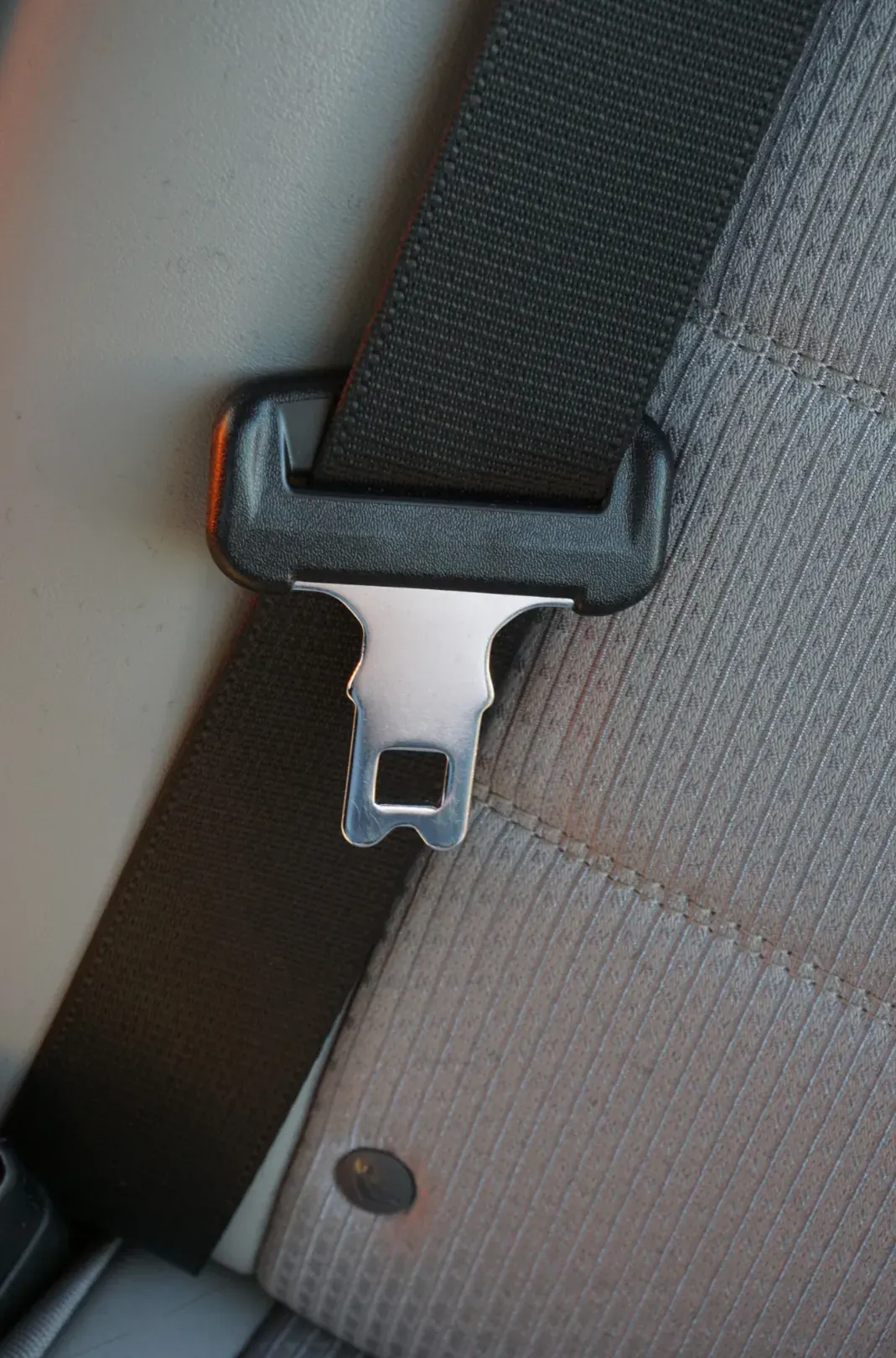
Close-up of a seat belt latch plate resting on woven webbing, showing the weave and edge finish. Webbing weave · Latch plate
  • Webbing — what varies
  • WidthSupplied in defined widths; the vehicle's hardware determines which applies
  • Weave & finishAffects surface feel, edge durability and how the belt runs through guides
  • LengthAlways specific to the vehicle and seating position
  • Common damageCuts, fraying, burns, chemical staining, stiffening, fading
REF 02

Tongue (Latch Plate)

The metal plate that engages the buckle. On most three-point belts it is a sliding tongue: the webbing passes through a slot in the plate, allowing it to move freely along the belt. This is what lets a single length of webbing serve as both the lap and shoulder section, and it is why the belt adjusts itself as it is drawn across the body.

Some designs use a fixed or semi-locking tongue instead, which behaves differently once the belt is latched. Others include a plastic stop or button on the webbing to keep the tongue within easy reach when the belt is stowed.

Because it is handled every time the belt is used, the tongue accumulates wear at the point where it passes through the buckle. Deformation, scoring or a plate that no longer slides freely on the webbing are all reasons for inspection.

  • Tongue — what varies
  • TypeSliding, fixed or semi-locking, depending on the assembly design
  • Plate profileShape and slot dimensions are matched to the buckle it engages
  • Webbing stopsSome designs position the tongue with a stop button or sewn stop
  • Common damageBending, scoring, sharp edges, binding on the webbing
Terminology. Tongue, latch plate, clip and buckle tongue are all used for this part in everyday speech. When describing a fault, saying which half is attached to the webbing removes most of the confusion.
REF 03

Buckle and Stalk

The buckle is the receiving half of the latch. It must accept the tongue with a clear, positive engagement, hold it against significant load, and release cleanly at a light press of the button — three requirements that pull in different directions, which is why the internal mechanism is more involved than it appears.

The buckle is carried on a stalk: either a rigid metal arm or a short length of webbing or cable, anchored to the seat frame or the vehicle floor. Stalk type and length are part of the vehicle's design, positioning the buckle where the occupant can reach it and where the belt runs correctly across the body.

Many vehicles also integrate a switch in the buckle to detect whether the belt is latched, feeding the belt-reminder system. Where that is present, the buckle is an electrical component as well as a mechanical one.

  • Buckle — what varies
  • MechanismPush-button is most common; lift-lever styles appear in some applications
  • StalkRigid arm or flexible strap; length set by the seat design
  • MountingBolt size, mounting eye and orientation are vehicle-specific
  • ElectricalMay include a latch-detection switch and connector
  • Common faultsWeak latching, self-release, stiff release, contamination inside the housing
REF 04

Retractor

The retractor stores unused webbing on a spring-loaded spool, keeps the belt close to the body by taking up slack, and locks the webbing when required. It is the most mechanically complex part of a conventional assembly and the one whose behaviour occupants notice most.

Locking is typically triggered in one or both of two ways: by sudden vehicle deceleration, sensed within the retractor, or by rapid withdrawal of the webbing. This is why pulling a belt sharply can lock it while drawing it out smoothly does not — normal behaviour, not a fault.

Many vehicles also provide a switchable mode used when installing a child restraint, in which the retractor allows webbing to be pulled out fully once and then only retracts. How this is engaged, and whether it exists at all, depends entirely on the vehicle — the handbook is the authority.

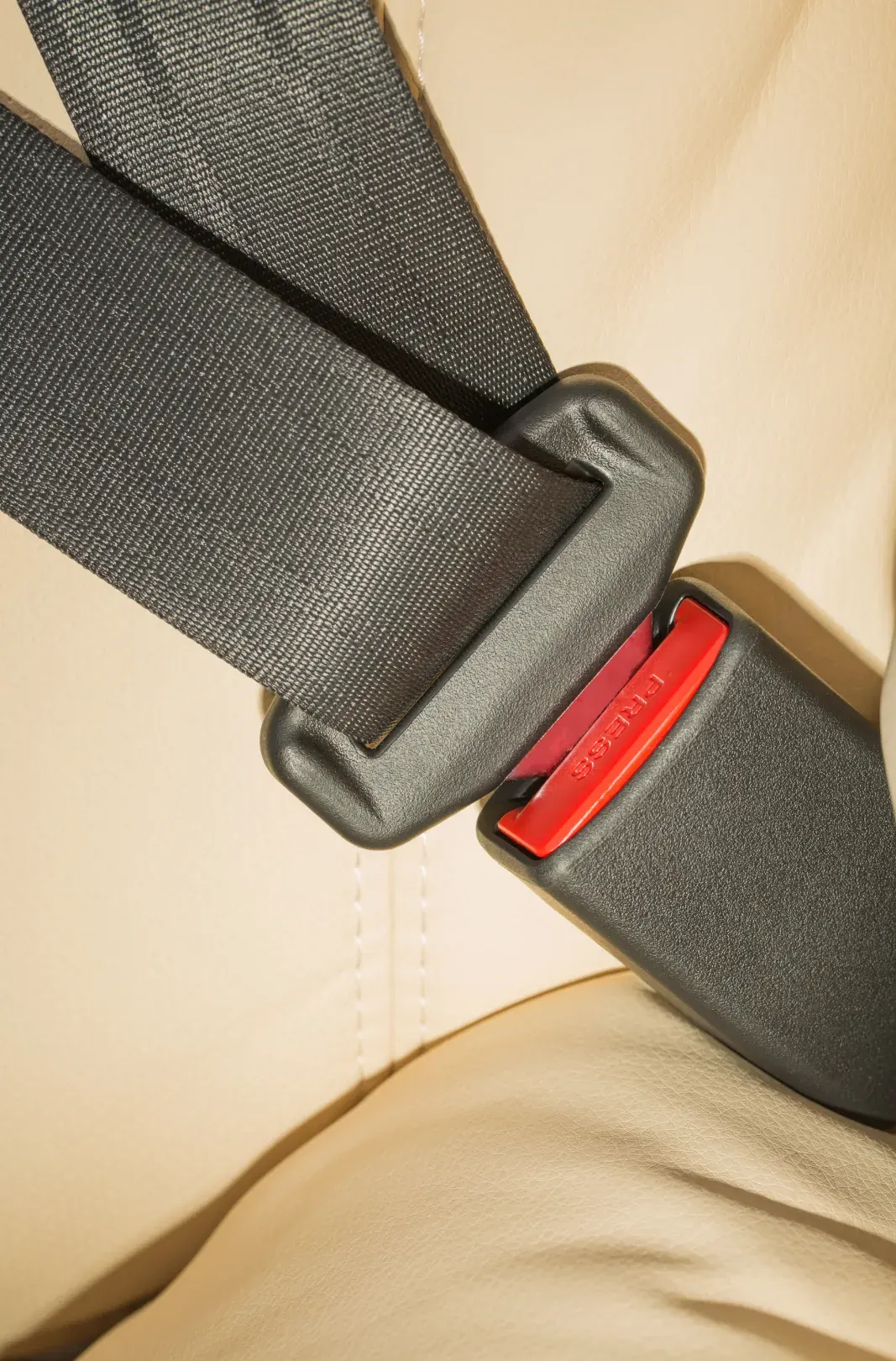
Seat belt webbing routed over a light-coloured vehicle seat toward the buckle. Webbing run · Seat routing
  • Retractor — what varies
  • LockingVehicle-sensitive, webbing-sensitive, or both
  • MountingPillar, seat structure or body panel; orientation matters
  • ModesSome offer a switchable mode for child restraint installation
  • IntegrationMay be combined with a pretensioner in modern vehicles
  • Common faultsSlow or partial take-up, jamming, unpredictable locking
REF 05

Anchorages, Guides and Hardware

Anchorages are the reinforced points on the vehicle structure that the assembly bolts to. They are designed into the vehicle — their position, the strength of the surrounding structure and the fasteners used are all engineering decisions made long before a belt is fitted. This is the clearest reason a seat belt cannot simply be mounted wherever it seems convenient.

Between anchorages, the webbing may pass through guides: an upper anchorage or D-loop that positions the shoulder section, sometimes height-adjustable on the B-pillar, plus guide loops or trim features that keep the belt on its intended path.

The hardware itself — anchor plates, bolts, spacers, bushes and trim covers — is specified rather than generic. Substituting general-purpose fasteners is not a shortcut; it changes the load path the belt depends on.

  • Anchorage — what varies
  • PositionsSet by vehicle design; not relocatable without engineering assessment
  • FastenersSpecified bolt size, thread and torque figure
  • Height adjustUpper anchorage may be adjustable on the pillar
  • GuidesD-loop, guide loops and trim features shape the belt path
  • InspectionLook for movement, corrosion and damaged or missing covers
Do not improvise anchorages. Adding, moving or reinforcing a mounting point is structural work requiring qualified automotive engineering input and compliance with applicable regulations.
REF 06

Pretensioners and Load Limiters

Many modern vehicles combine the belt with two additional functions. A pretensioner removes slack from the webbing at the onset of a severe incident, pulling the occupant firmly against the seat before the main loading occurs. A load limiter then allows a controlled amount of webbing to pay out, capping the peak force applied across the chest.

These are described here for understanding only. Pretensioners are linked to the vehicle's restraint electronics and may contain energetic components. They are safety-critical, they are subject to specific handling, storage and disposal requirements, and anything involving them belongs to qualified professionals working to the vehicle manufacturer's procedures.

If your enquiry concerns a belt that includes a pretensioner, say so — it changes what can sensibly be discussed and who should carry out the work.

Safety-critical

Pretensioner-equipped assemblies, restraint electronics and airbag-linked components are not general-purpose parts. Handling, fitting and disposal follow the vehicle manufacturer's instructions and applicable regulations, carried out by qualified personnel.

02 — Terminology

The same part, several names

Seat belt vocabulary is inconsistent across workshops, regions and manufacturers. This is what people usually mean.

Webbing
The woven strap itself.Also called: strap, belt, band
Tongue
The metal plate on the webbing that engages the buckle.Also called: latch plate, clip, buckle tongue
Buckle
The receiving half with the release button.Also called: receiver, catch, socket
Stalk
The arm or strap carrying the buckle.Also called: buckle stalk, buckle stem
Retractor
The spool assembly storing and locking webbing.Also called: reel, inertia reel, spool
D-loop
The upper guide positioning the shoulder section.Also called: upper anchorage, turning loop, slip guide
Anchorage
A reinforced mounting point on the vehicle.Also called: mounting point, anchor, fixing point
Assembly
The complete belt with all its components.Also called: belt set, complete belt, kit

03 — Identify It

"It's the bit that..." — translated

How everyday descriptions usually map onto components. Photographs still beat any description, but this helps get an enquiry started.

"The clip won't click in"

Buckle or tongue

Usually the buckle mechanism, sometimes a damaged tongue. Photograph both halves so the fault can be placed correctly.

"The strap won't pull back in"

Retractor

Take-up problems point to the retractor, though twisted webbing or a trapped belt path can mimic the same symptom.

"It locks up and won't let me move"

Retractor locking

Locking under sudden pull is normal. Locking during ordinary movement, or refusing to release, is not.

"The belt is fraying at the edge"

Webbing

Note where along the length it sits — damage at a guide or door shut line often points to a routing problem too.

"The bit on the pillar moves"

Upper anchorage

Could be a height-adjustable anchorage working as designed, or a genuinely loose mounting. Worth confirming which.

"The belt sits across my neck"

Fit or adjustment

Often an adjustment or seating-position issue rather than a faulty part — but worth checking the belt is the correct one for that seat.

Component Enquiries

Know the part you need?

Tell us the component, the vehicle and the seating position. If you are not certain which part it is, a photograph will settle it.