The lap section
Low and snug across the hips, sitting on the pelvis — not up across the soft area of the stomach. This is where the belt should take load.
Safety Resource
A plain-language reference on what seat belts do, how to wear one properly, what misuse looks like, when to have a belt inspected, and what to keep in mind when children travel.
About this guide This is general educational information about seat belts and how they are used. It is not a substitute for your vehicle manufacturer's handbook, the instructions supplied with any child restraint, professional inspection by a qualified automotive technician, or the road safety regulations that apply where you drive. Where this guide and any of those sources differ, follow the official source. If you are dealing with an injury or an emergency, seek appropriate professional help rather than consulting a website.
A vehicle and its occupants travel at the same speed. When the vehicle stops abruptly — against another vehicle, a barrier, or anything else — the vehicle's structure absorbs a great deal of that energy through deliberate deformation. The occupants, however, keep moving at the speed they were travelling until something stops them too.
A seat belt is what makes that "something" a designed part of the vehicle rather than an accidental one. It connects the occupant to the vehicle's structure so that they decelerate with it, over a longer distance and through parts of the body better able to tolerate load — principally the pelvis and the rib cage.
Modern vehicles are engineered as complete restraint systems. Airbag deployment, interior padding, seat design and structural crumple behaviour are all developed around an occupant who is belted and therefore in a predictable position. An unbelted occupant is not simply unprotected by the belt; they are also outside the assumptions the other systems were designed around.
This is the reason an airbag is described as a supplementary restraint. It supplements the belt. It does not replace it.
Restraint applies to every seating position, not just the front. An unrestrained rear occupant continues moving forward in a collision, which puts both that person and anyone in front of them at risk. Short journeys are no different in this respect — the physics does not scale with distance travelled.
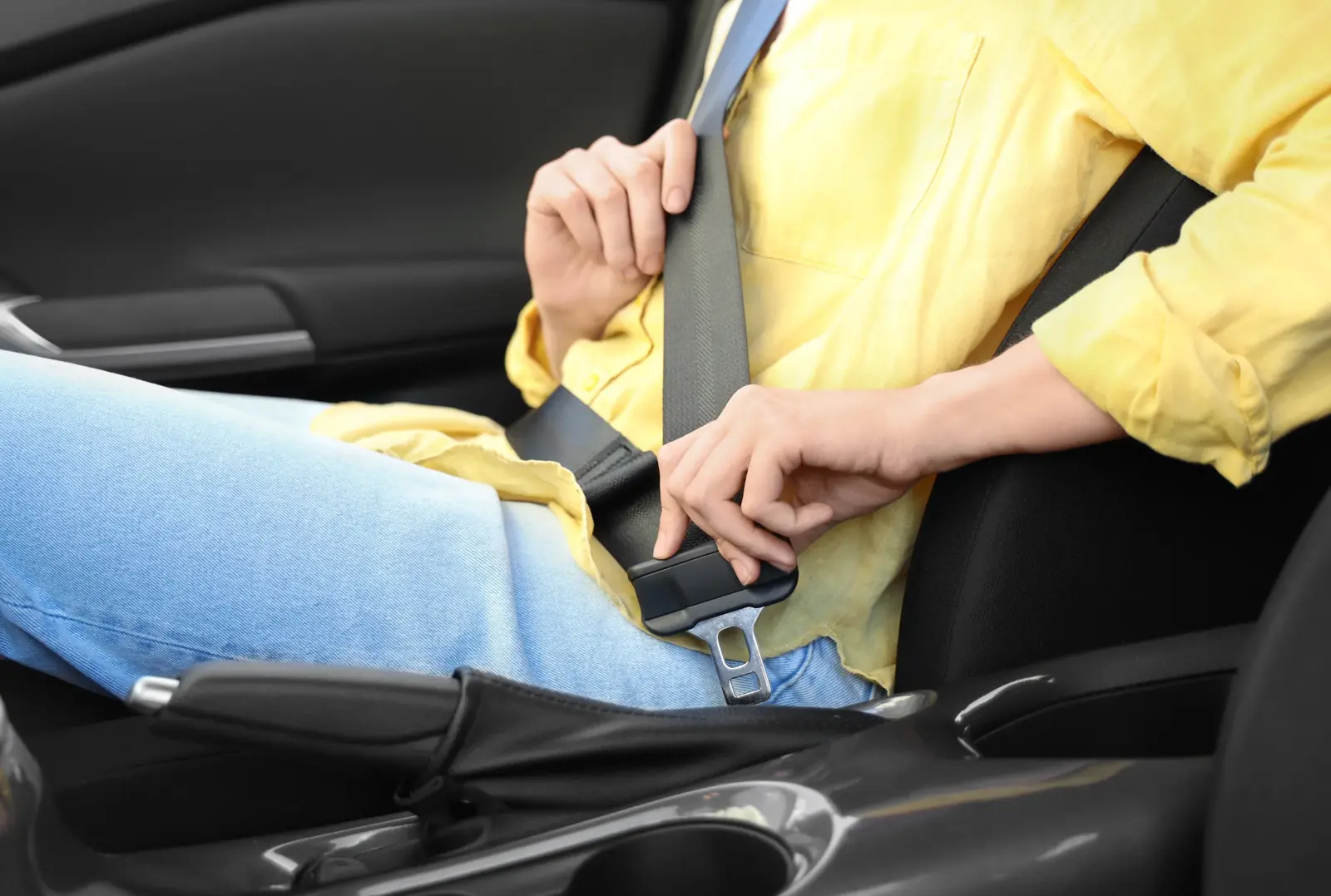 Lap section · Correct position
Most people put a belt on the same way every day without thinking about it. That is fine when the habit is right, and a problem when it is not — because a belt worn incorrectly can behave very differently from one worn as intended.
Low and snug across the hips, sitting on the pelvis — not up across the soft area of the stomach. This is where the belt should take load.
Flat across the middle of the shoulder and diagonally across the chest. Not against the neck, not sliding off the shoulder edge.
Untwisted along its full length, lying flat against the body, with slack taken up by the retractor rather than left hanging.
Sit fully back in the seat, with your back against the backrest and the seat adjusted to a normal driving or travelling position.
Draw the belt out smoothly rather than snatching it — a sharp pull will often lock the retractor.
Check the webbing is not twisted anywhere between the anchorage, the shoulder and the tongue.
Insert the tongue into the buckle until it clicks positively, then tug the belt to confirm it has engaged.
Settle the lap section low across the hips, then let the retractor draw the remaining slack out of the shoulder section.
If your vehicle has a height-adjustable upper anchorage, set it so the belt crosses the middle of your shoulder.
Misuse is rarely deliberate. It usually comes from comfort, habit or an attempt to solve an irritation — and it changes how the restraint behaves.
If a belt is genuinely uncomfortable in normal use, that is worth looking into rather than working around. Seat adjustment, upper anchorage height, or a fault in the assembly are all more likely explanations than "belts are just like that".
You do not need to be a technician to notice that something has changed about a seat belt. Most faults announce themselves — the difficulty is that they do so quietly, and it is easy to adapt to them without noticing.
Draw the belt fully out and run it through your hand along its whole length, looking at both faces and both edges. Latch and release the buckle a few times. Let the belt retract and watch whether it takes up all the slack smoothly. Glance at each mounting point for movement, corrosion or missing covers.
That is the whole check. Doing it occasionally — when cleaning the car, at a service, at the start of a shift — catches the majority of developing problems.
Cuts, fraying, burns, heavy staining or stiffened webbing. A buckle that will not latch cleanly, releases on its own, or is hard to release. A retractor that will not take up slack, jams, or locks during ordinary use. Any movement or corrosion at an anchorage. And any belt that was worn during a collision, however normal it looks afterwards.
Your vehicle handbook and service schedule may set out specific inspection points for your model. Where they do, follow them — they are written for the vehicle in front of you.
Any of these means: stop relying on that belt and have it assessed by a qualified automotive professional.
Seat belts ask very little in the way of maintenance. Most of the damage done to them in the name of care comes from cleaning products and improvisation.
Use the mildest approach that works, and check your vehicle handbook first — some manufacturers give specific guidance. Avoid solvents, bleach, strong detergents and aggressive stain removers, which can affect the fibres and the finish on the webbing. Let webbing dry fully before allowing it to retract, so damp material is not wound onto the spool.
A large share of webbing damage comes from the belt being trapped: caught in a door as it closes, pinched in a folding seat mechanism, or dragged over a load edge. Check that stowed belts are properly retracted before doors and seats are closed.
Anything that a wipe with a mild cleaner and a clear belt path will not solve is a matter for a qualified automotive professional.
A seat belt is safety equipment with a working life, not a permanent fixture. There comes a point where inspection is no longer the answer and the assembly, or part of it, needs replacing.
The clearest cases are physical damage to the webbing, a buckle or retractor that no longer works reliably, damage or corrosion at anchorage points, and use during a collision. Beyond those, condition matters more than age: a belt in a vehicle that works hard in a harsh environment can reach that point far sooner than one in light use.
The replacement must be correct for the vehicle and position. Not similar, not "off the same model" — correct for that vehicle, that seating position and that side.
Installation is a qualified job. Anchorage points, fasteners, torque figures and belt routing follow the vehicle manufacturer's specification. A correct part fitted incorrectly does not solve the problem it was bought to solve.
Child passenger safety is a specialised subject, and this section deliberately stops short of giving specific instructions. What follows are the principles that consistently matter, together with a clear direction on where to get authoritative guidance.
A vehicle's seat belts are dimensioned around adult body proportions. On a smaller body, the lap section tends to ride up onto the abdomen and the shoulder section crosses the neck — which is why child restraints and booster seats exist: to position the child so the vehicle's belt, or the restraint's own harness, sits where it should.
A child restraint has to suit the child (by the measure the restraint specifies), the seat it is being installed in, and the vehicle itself. A restraint that is right in two of those three is not right.
Most of the value in a child restraint comes from correct installation. Follow the restraint manufacturer's instructions and your vehicle handbook together — including how your vehicle's belts or anchorage systems are meant to be used for that purpose, which varies between vehicles.
The restraint manufacturer's instructions, your vehicle handbook, and the child restraint regulations and official road safety guidance that apply where you live. Many regions also offer child restraint checking services staffed by trained personnel. Those sources take precedence over anything on this website.
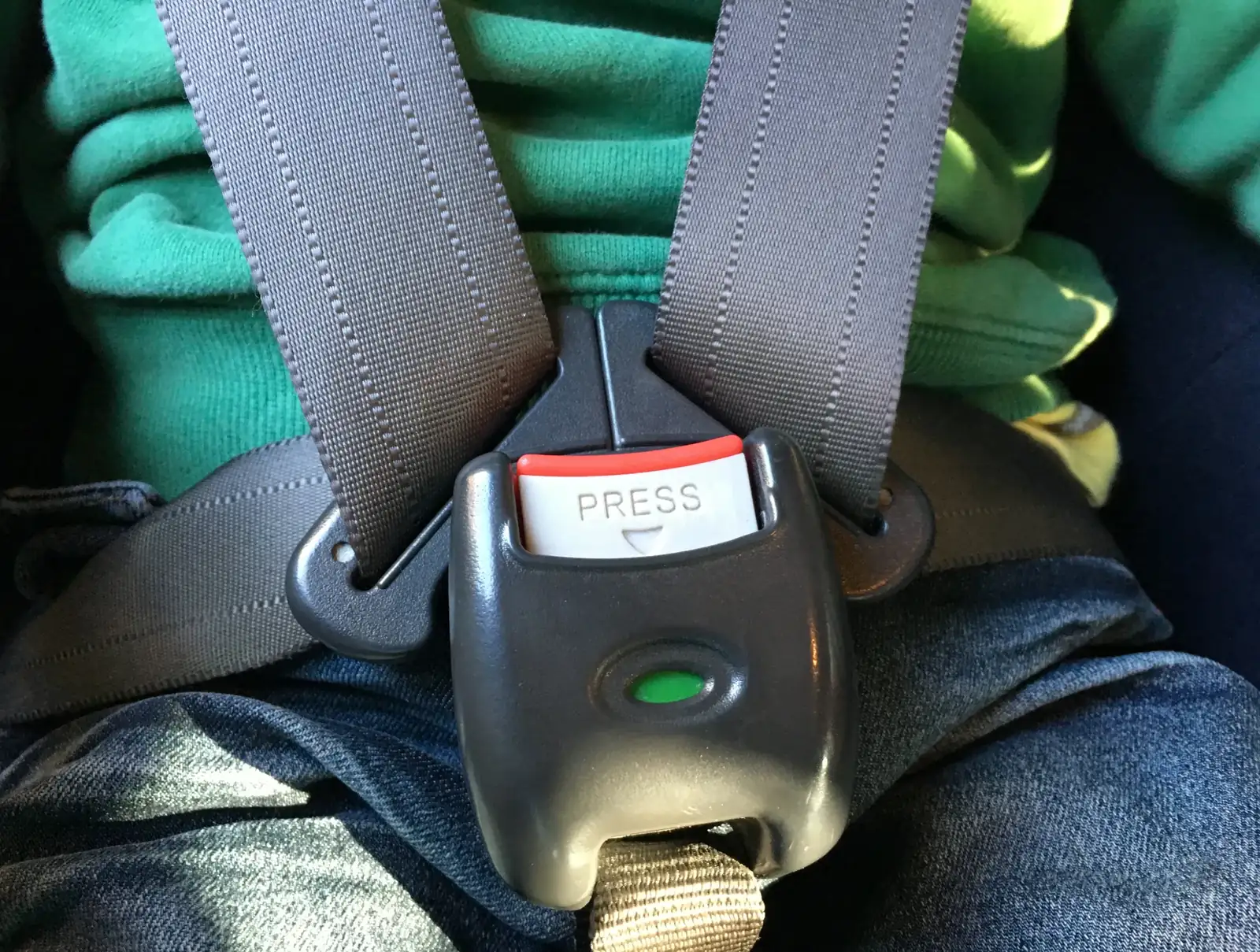 Child restraint · Harness buckle
Almost every practical question about a seat belt ends in the same place: it depends on the vehicle. That is not evasion — it is the nature of a component designed around a specific structure.
Your vehicle handbook covers most of it. Service documentation and a qualified automotive professional cover the rest. Where regulations apply to your vehicle or operation — commercial vehicles in particular — those requirements sit above general guidance.
Product Enquiries
We can help with seat belt products, categories and components. For advice about your specific vehicle's condition, please speak to a qualified automotive professional.